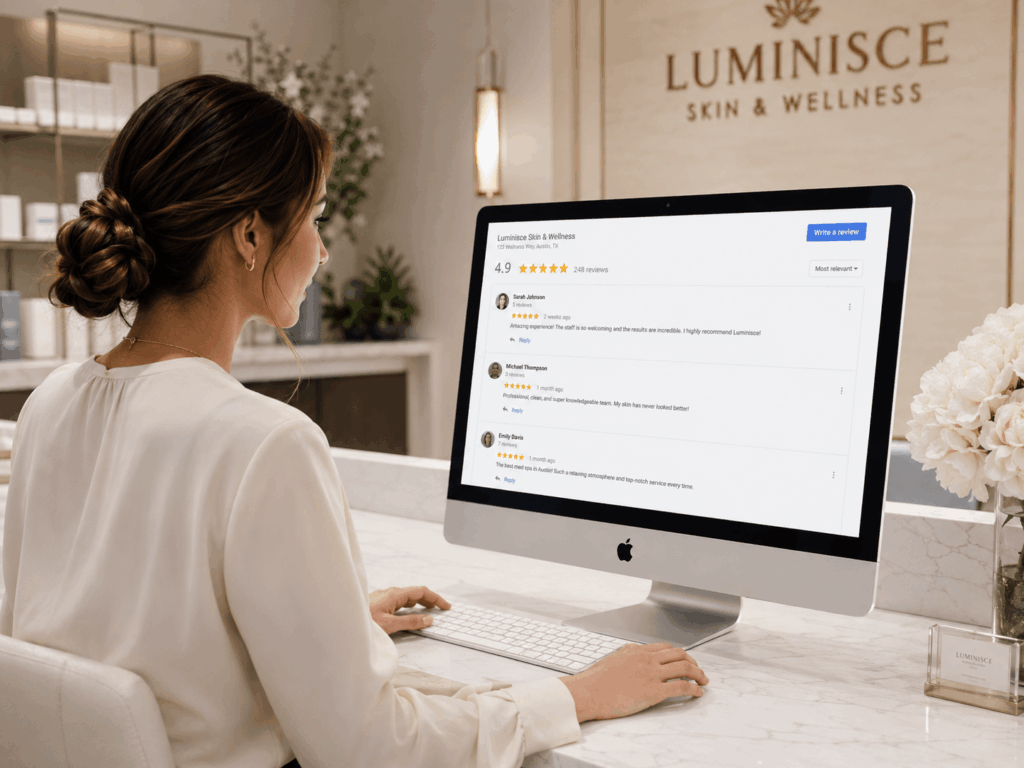
Reviews matter. You already know that. The question every practice should be asking right now is not whether to collect them, but how. Because in April 2026, Google changed the rules, and a review process that was standard across the industry for years is now against policy.
We are sharing this because we want every Aesthetix CRM client to understand what changed and why. As part of these changes, we are removing gated review functionality from the platform and updating clients to a fully compliant review process. This article explains what that means, why it is happening, and what (if anything) you need to do on your end.
The short version: this is a good change, most of the work happens on our side, and a compliant review process is actually simpler and more effective than what came before.
What Is Review Gating?
Review gating is the practice of filtering which patients get asked to leave a public review based on how satisfied they are.
It usually works like this. After a visit, the patient receives a quick feedback request. If they respond positively (four or five stars), they are sent to leave a Google review. If they respond negatively (one or two stars), they are routed to a private internal form, where the issue can be handled quietly and away from the public profile.
On the surface, the logic makes sense. You want to resolve problems before they go public, and you want your Google profile to reflect your happy patients. For years, sentiment-based review flows like this were a standard setup across CRMs and reputation tools.
The problem is that Google has always technically prohibited it, and as of April 2026, they are actively enforcing it.
What Changed in April 2026
Google updated its Maps review policy across two days, on April 16 and 17, 2026. Here is what is now explicitly off the table:
- Review gating. Filtering patients by sentiment before sending a review link. This was always against policy. It is now being actively enforced, and Google’s systems are specifically built to detect the statistical signature of a gated review funnel.
- Asking for reviews while the patient is still on your premises. This includes the front-desk tablet, the iPad handed over at checkout, verbal asks at the counter, and any review kiosk in your waiting area.
- Review kiosks and shared devices. Any setup where patients leave reviews on a practice-owned device is now explicitly prohibited. Multiple reviews from the same device or IP address are also a spam signal to Google.
- Staff review quotas. Setting targets like “we need ten new reviews this week,” tying front-desk bonuses to review counts, or running a leaderboard for which provider gets the most reviews.
- Asking patients to mention specific content. Directing patients to name a specific injector or provider, or to mention a specific treatment, in their review.
To enforce this, Google rolled out Gemini-powered moderation that screens reviews before they are ever published, and began sending email alerts to verified Business Profile owners when something changes on their listing. According to Google’s 2025 Trust and Safety Report, its systems blocked or removed more than 292 million policy-violating reviews last year. Those same systems are now applying the new rules. This is not theoretical. Reviews are already disappearing from profiles, often with no notification at all.
Why This Matters
The enforcement is real, and it now runs on two tracks.
Google can remove individual reviews or sweep an entire profile, reduce your visibility in the local map pack, or suspend the listing outright. The pattern is the signal: a profile that only ever receives glowing reviews through one channel, while criticism never reaches Google, is exactly what the AI is trained to catch.
Then there is the FTC. In 2022, the FTC reached a $4.2 million settlement with the retailer Fashion Nova for suppressing reviews below four stars, the agency’s first case built entirely on hiding negative reviews. In 2024, the FTC finalized a rule that explicitly bans both fake reviews and the suppression of genuine ones, backed by civil penalties. Review gating sits squarely inside what that rule prohibits.
And beyond any regulator, there is a trust problem. The vast majority of consumers actively seek out negative reviews before making a decision, and a profile with nothing but five-star praise reads as too clean to be real. Your prospective patients are sophisticated. A flawless 5.0 with no criticism anywhere does not build confidence. It quietly erodes it.
What We Are Changing, and What It Means for You
In response to these changes, Aesthetix CRM is removing gated review functionality from the platform and moving every client to a single, compliant review request. We made the decision to get ahead of this proactively, rather than wait for problems to surface on client profiles.
Here is what that looks like in practice:
We handle the migration. Your review automation is being updated on our side. The old sentiment-filtered flow, where happy patients were routed to Google and unhappy ones to a private form, is being replaced with one neutral review request that goes to every patient the same way. You do not need to rebuild anything.
Same request, every patient. When an appointment is completed, the patient receives a review request by text, email, or both. Same request, same language, every patient. The only thing personalized is their first name. There is no satisfaction filter and no split path. The system also includes safeguards on how often any single patient is contacted and how many requests go out at once, so the flow stays natural and nobody gets bombarded.
Everything in one place. Aesthetix brings your reviews from Google, Facebook, and other platforms into one place, so your team is not logging into five different sites to keep up. You can respond directly from inside the platform, with AI-assisted drafting to help you reply quickly and consistently.
On your website. A review display widget puts your genuine reviews and your responses directly on your site. That helps with search, gives AI models real content to work with, and shows prospective patients that you are active and engaged before they ever open your Google profile.
We built all of this to keep you compliant and to produce better results, because an authentic, unfiltered review profile is more credible to patients, more useful to AI, and more sustainable over time.
What the Compliant Approach Looks Like
If you want to understand the principles behind the new setup, here they are. The compliant approach is simpler than gating, not harder:
- One request, sent to everyone. The same review request goes to every patient, not just the ones you expect to be happy.
- After the visit, not during it. Sent once they have left, by text or email. Never at the front desk, never on a practice device.
- Neutral language. No asking for a five-star review and no asking for a positive one. The invitation is simply to share their experience. “We would appreciate it if you could share your experience on Google” is compliant. “If you loved your results, leave us a five-star review” is gating in a friendlier outfit.
- Paced as a steady drip. Not fifty requests in one afternoon. A consistent, natural flow looks natural because it is.
- No incentives. No discounts, no loyalty points, no entry into a giveaway, no free units in exchange for a review. This has always been against policy and enforcement is tightening.
What About Negative Reviews?
This is the part that makes practice owners nervous. “If a request goes to everyone, won’t I get more negative reviews?”
Maybe a few. But here is what experience consistently shows: the practices that respond to criticism well build more trust than the ones who try to bury it. A thoughtful, professional response shows every future patient reading along that you listen and that you take care of people. Research has found that a meaningful share of unhappy customers will keep doing business with a company that simply responds to their complaint, and that many will even update their review once an issue is resolved. A negative review handled gracefully is not damage. It is a conversion opportunity.
There is a tougher version of this too. If you keep receiving the same complaint (the same wait times, the same front-desk friction, the same provider mentioned the same way), that is a signal, not a coincidence. A one-off complaint is normal. Five in a row pointing at the same thing have one factor in common, and it is not the patients. Filtering those reviews out never fixed the underlying issue; it only hid the best early warning of it.
And remember the HIPAA layer. When you respond to an upset patient publicly, resist the urge to set the record straight with details. You cannot win a clinical argument in a Google reply without disclosing protected health information, and the regulators have been crystal clear that they will penalize it. Acknowledge, apologize for the experience in general terms, and take it offline.
What You Need to Do
Most of this is handled on our side. Here is the short list of what is helpful to do on yours:
- Stop on-premises review requests. No front-desk tablet, no kiosk, no asking for a review before the patient walks out.
- Update any saved messaging or scripts. Make sure nothing asks for positive or five-star reviews, and nothing directs patients to name a provider or mention a specific treatment.
- Brief your team on HIPAA-safe responses. Nobody on your staff should ever confirm a patient relationship or mention treatment details in a public reply. Make the safe response the default.
- Respond to the reviews you already have, especially the negative ones, the compliant way. This is where trust gets built.
- Do not worry about a slight dip in your rating. A 4.7 full of authentic, detailed reviews is stronger than a manufactured 5.0. Patients can tell the difference, and increasingly, so can AI.
Why This Connects to AI Visibility
There is one more reason this change works in your favor. AI tools and AI-powered search are now part of how patients find a practice, and they do not just count your stars. They read the actual text of your reviews.
That makes authentic, detailed reviews more valuable than they have ever been. A profile full of gated five-star reviews that all say “Great experience!” gives an AI almost nothing to work with. A profile with genuine reviews that mention specific treatments, real concerns, and real outcomes gives the AI the context it needs to recommend your practice to the right person. A compliant review process does not just remove risk. It strengthens the exact signal that increasingly sends new patients to your door.
The bottom line: doing reviews the right way keeps you compliant with Google, the FTC, and HIPAA all at once, and it builds a review profile that works for you everywhere, with patients, with the platforms, and with AI. That is why we are making this change, and why we think you will be glad we did.
Sources: Google Maps review policy update (April 16 to 17, 2026) and Google’s 2025 Trust and Safety Report; U.S. Federal Trade Commission, Fashion Nova settlement (2022) and the FTC’s 2024 Rule on the Use of Consumer Reviews and Testimonials; U.S. Department of Health and Human Services, Office for Civil Rights enforcement actions (Elite Dental Associates, 2019; New Vision Dental, 2022).