Patient Retention Strategies for Med Spas and Aesthetic Practices

By Eric Dunn (CEO & Co-Founder, Aesthetix CRM)
The most expensive patient in your practice is the one who visits once.
You paid to acquire them: the ad, the consult, the front desk time, maybe an intro offer. If they never come back, that cost is never recovered. And in aesthetics, it happens constantly. CorralData’s H1 2026 benchmark of 100+ aesthetics brands found that 43.9% of clients at the median brand visited exactly once in the half year.
That is the single largest pool of untapped revenue in most practices, and it is why patient retention deserves as much attention as lead generation. Depending on the study and the industry, acquiring a new customer costs five to 25 times more than keeping one, and Bain’s research cited in the same piece found that a 5% increase in retention can raise profits by 25% to 95%.
This guide covers how to measure patient retention, what good looks like in aesthetics, and ten strategies that move the number.
What Is Patient Retention?
Patient retention is the share of your patients who keep coming back over time. In aesthetics, where treatments are elective and cash-pay, nothing holds a patient in place except the experience and the relationship. There is no insurance network, no referral requirement, and no clinical emergency that sends them back to you. If you do not give them a reason to return, they drift to whoever reaches out first.
How to Calculate Your Patient Retention Rate
There is no single official formula, so pick one and use it consistently. The three most useful in aesthetics:
1. Period retention rate. Of the patients who visited in one period, how many visited again in the next?
Retention rate = patients who visited in both periods ÷ patients who visited in the first period × 100
Example: 1,200 patients visited in the first half of the year. 540 of them also visited in the second half. Your retention rate is 540 ÷ 1,200 = 45%.
2. New patient 90-day return rate. Of the patients whose first visit fell in a given month, how many came back within 90 days? This is the most sensitive early warning, because the first 90 days decide whether a new patient becomes a regular.
3. Rebooking rate. Of completed visits, how many have a next appointment booked within 90 days? This measures habit, and it is the one your front desk can influence at checkout.
Count patients rather than visits, use completed appointments rather than bookings, and exclude patients who only purchased retail if you want a treatment-focused view.
Patient Retention Benchmarks for Aesthetics
CorralData’s benchmark gives the clearest public picture of what normal looks like:
| Measure | Bottom quarter | Median | Top quarter |
|---|---|---|---|
| New clients returning within 90 days | 36% | 45.8% | 62% |
| Visits rebooked within 90 days | 58% | 69% | 73% |
| Clients who visited only once in the half | 51.4% | 43.9% | 38.9% |
| Prior-half clients lost (churn) | 47.6% | 43.5% | 37.6% |
| Completed visits per active client | 2.0 | 2.3 | 2.8 |
Two caveats. These brands run on CorralData’s platform and include wellness practices, whose recurring visit models push the top of the range above 80%; CorralData notes that aesthetics brands cluster between 35% and 55% on 90-day new client return. And the ranges are wide, which is the point: the difference between the bottom and top quarter is the difference between a practice that refills its own calendar and one that has to buy every visit.
Why Aesthetic Patients Leave
Patients rarely leave because of one bad experience. More often, nothing happens:
- Nobody reaches out when they are due. A neurotoxin patient is on a cycle, but if nobody contacts them near the end of it, the cycle quietly ends.
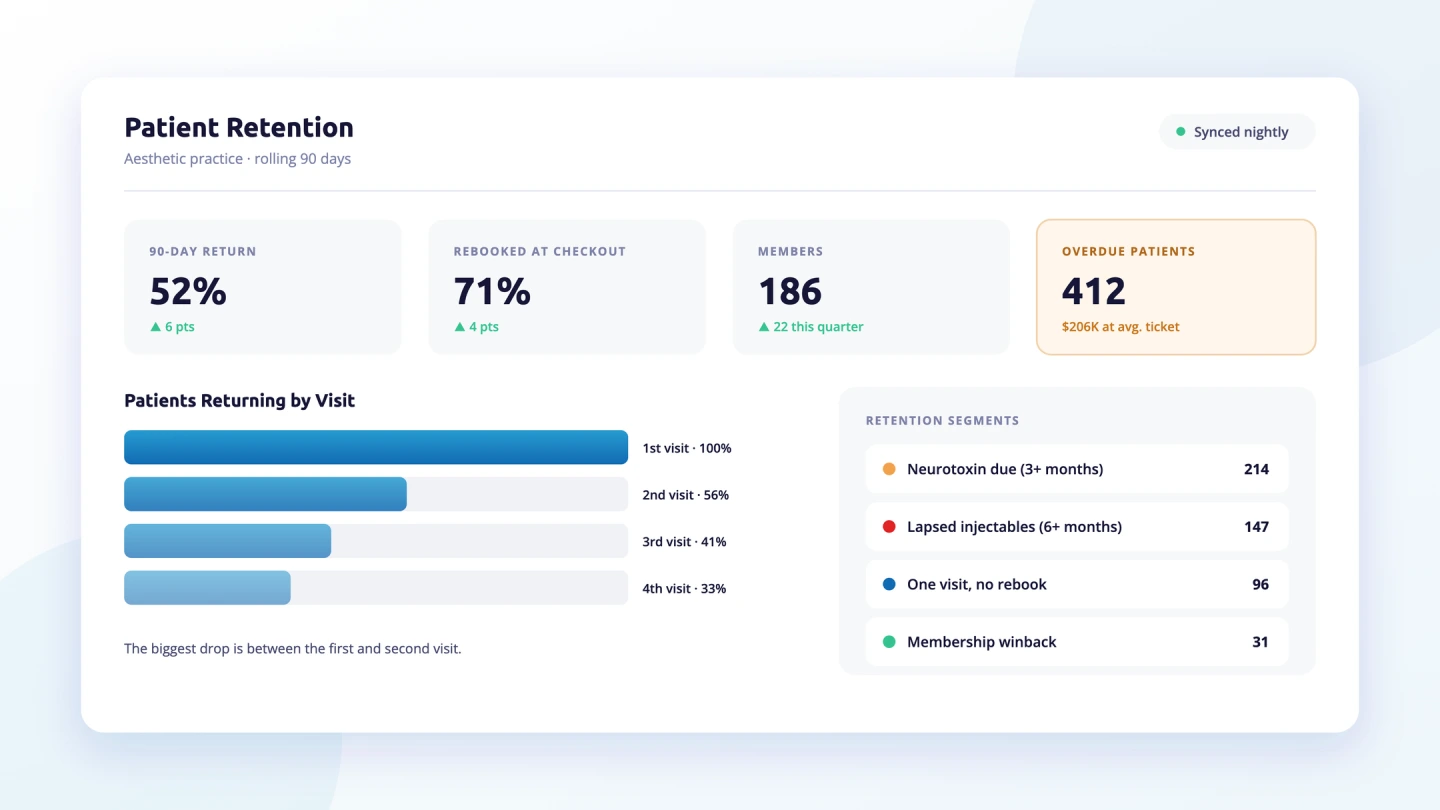
- The second visit never gets booked. The first visit is the easiest to win and the second is the easiest to lose.
- A competitor reaches out first. Another practice’s promotion lands in their inbox the week they were thinking about a touch-up.
- The follow-up stops after the treatment. No check-in, no aftercare message, no sense that anyone noticed they were there.
- They only knew you for one thing. A patient who came in for laser hair removal may not know you offer the facial or injectable they are about to buy elsewhere.
Every one of these is a communication problem, which is why patient retention is mostly a systems problem.
10 Patient Retention Strategies That Work
1. Win the Second Visit
The jump from one visit to two is the most valuable in the whole patient lifecycle. Give every new patient a specific reason and a specific time to come back: a follow-up check, a second session in a series, or the next step in a treatment plan. Then make sure someone confirms it before they leave.
2. Rebook at Checkout
The easiest moment to book the next appointment is while the patient is still in the building and happy with the result. Train the front desk to offer the next date at checkout for every treatment with a natural cycle, and track the rebooking rate weekly. The benchmark median is 69% of visits rebooked within 90 days; anything well below that is recoverable revenue.
3. Send Reminders on the Treatment Cycle, Not the Calendar
Generic monthly newsletters do not bring people back. A message timed to a patient’s own treatment history does. Most practices plan neurotoxin follow-ups around three to four months after treatment and other services on their own cadence. Build reminders off the date of the last treatment, personalized to the service the patient actually had, so the message arrives when they are due rather than when it suits your campaign calendar.
4. Follow Up After Every Treatment
A short check-in a day or two after treatment, with aftercare instructions and an easy way to ask questions, does three things: it improves outcomes, catches problems before they become bad reviews, and tells the patient someone is paying attention. It is the cheapest loyalty program there is.
5. Reactivate Lapsed Patients Systematically
Lapsed patients are the fastest revenue in the practice: they already chose you once. Define lapsed for each service (for example, an injectable patient with no visit in six months), build the list automatically, and run a reactivation campaign that re-qualifies new patients every day they cross the line. In one anonymized multi-location practice using Aesthetix Activate, a single neurotoxin reactivation campaign produced a 10.1% matured booking rate at $469 per completed visit, roughly 24 days from outreach to appointment.
6. Offer a Membership
Memberships turn occasional visits into a recurring habit with recurring revenue. In CorralData’s data, members spent 2.5 times more than non-members at the median brand and retained 35 percentage points better. Members self-select, so some of that gap would exist anyway, but no brand running a program saw members underperform. Our guide to med spa loyalty programs and memberships covers how to structure one.
7. Reward Loyalty and Referrals
Points for visits, reviews, and referrals give patients a reason to choose you over a competitor running a one-time promotion. A two-sided referral reward (something for the referrer and the friend) also brings in new patients who arrive already trusting you.
8. Introduce Patients to Your Other Services
Patients who use more than one category of service stay longer. CorralData found that patients on both wellness and aesthetic services retain roughly twice as well as aesthetics-only clients. Use treatment history to suggest a logical next service: skincare for laser patients, injectables for facial patients, maintenance treatments after a series.
9. Ask for Feedback and Act on It
Send a short satisfaction survey after visits. Route happy patients to leave a review, and route unhappy ones to a manager who calls them the same day. A complaint handled well often produces a more loyal patient than one who never had a problem. Reputation management belongs in the same workflow, not a separate tool.
10. Measure Retention Every Month
Pick your three numbers (period retention, 90-day new patient return, rebooking rate) and review them monthly by provider and by service. Add a lapsed patient count: the number of patients who are overdue for their usual service, multiplied by your average treatment value. That number usually makes the case for everything above.
Retention Versus Reactivation
The two are related but not the same. Retention is keeping active patients on their cycle, so they never lapse. Reactivation is winning back patients who already have. A healthy practice runs both: retention workflows for everyone currently active, and reactivation campaigns for everyone who has slipped past their due date. Retention is cheaper per patient; reactivation is where the backlog of revenue sits.
How Aesthetix CRM Supports Patient Retention
- Treatment-aware segments. With Aesthetix Activate, your EMR history feeds nightly segments such as lapsed injectables, treatment anniversaries, membership winbacks, and cross-sell opportunities, which sync into campaigns in the CRM.
- Automated cycle reminders and aftercare. Workflow automations send post-treatment check-ins, aftercare, and cycle-based reminders, with consent capture, quiet hours, and opt-out handling built in.
- Memberships and recurring billing. AX Pay handles subscriptions and recurring payments for memberships and treatment packages.
- Reviews and feedback. Reputation management sends review requests automatically after appointments and alerts you to new reviews in real time, and workflows can route survey responses to the right person.
- Every conversation in one place. Replies from every channel land in one inbox on the patient record, so the whole team sees the relationship.
Patients book themselves from links in these messages, or by replying and speaking with your team; appointments stay on your own calendars or your EMR’s.
Frequently Asked Questions
What is patient retention?
Patient retention is the share of patients who return to your practice over time. In aesthetics, where care is elective and cash-pay, it is driven almost entirely by experience and communication: rebooking at checkout, reminders on the patient’s treatment cycle, follow-up after visits, and reaching out to patients before they lapse.
How do you calculate patient retention rate?
Divide the number of patients who visited in both of two consecutive periods by the number who visited in the first period, then multiply by 100. For example, if 1,200 patients visited in the first half of the year and 540 of them also visited in the second half, your retention rate is 45%. Also track the 90-day return rate for new patients and the share of visits rebooked within 90 days.
What is a good patient retention rate for a med spa?
In CorralData’s H1 2026 benchmark of 100+ aesthetics brands, the median brand brought 45.8% of new clients back within 90 days, and aesthetics brands clustered between 35% and 55%. About 69% of visits were rebooked within 90 days at the median. A practice in the top quarter of either measure is retaining well.
Why is patient retention important?
Because acquiring a new patient costs far more than keeping an existing one, and returning patients account for most of the revenue in an aesthetic practice. At the median aesthetics brand, 43.9% of clients visit only once in a half year, so improving retention is usually the fastest way to grow without spending more on ads.
How can I improve patient retention at my practice?
Start with the second visit and rebooking at checkout, then add reminders timed to each patient’s treatment history, post-treatment follow-up, a membership or loyalty program, and systematic reactivation of lapsed patients. Measure retention monthly so you can see which changes work.
What is the difference between patient retention and patient reactivation?
Retention keeps active patients coming back on their usual cycle. Reactivation wins back patients who have already lapsed. Practices need both: retention prevents the backlog from growing, and reactivation recovers the revenue already sitting in it.
The Takeaway
Most practices try to grow by finding new patients. The faster path is usually keeping the ones they have. Win the second visit, rebook at checkout, reach out on each patient’s own cycle, and go back systematically to everyone who has drifted away.
If you want to see how many patients are overdue at your practice right now, book a demo and we will walk through it on your data.