Patient Engagement Software for Aesthetic Practices: The 2026 Guide

By Eric Dunn (CEO & Co-Founder, Aesthetix CRM)
Most aesthetic practices do not have a lead problem. They have a follow-up problem.
The consultation request comes in at 8pm and gets answered at 10am the next day. The patient who came in for Botox twice last year has not been contacted since. The post-treatment check-in never goes out because the front desk is booking today, not tracking last quarter. None of that is a marketing failure. It is a patient engagement failure, and it is the single most expensive gap in most aesthetic practices.
This guide covers what patient engagement software actually does, why aesthetics needs something different from general healthcare, and how to tell whether a platform is working.
What Patient Engagement Software Actually Is
Patient engagement software is the layer that manages communication with patients between visits: capturing inquiries, responding to them, sending reminders and education, collecting feedback, and reaching out to people who have drifted away.
It is worth being precise about what it is not, because the categories get blurred in vendor marketing:
- It is not an EMR. Your EMR is the clinical record. It stores what happened at the visit. Patient engagement software works on the communication around the visit.
- It is not a patient portal. A portal is a place patients log in to. Engagement software goes out to patients on the channels they already use, which for aesthetics is overwhelmingly text.
- It is not just marketing automation. Marketing automation sends campaigns. Engagement includes the two-way conversation that follows, and the operational messages such as reminders and pre-treatment instructions.
A patient engagement platform is the combination: outbound communication, inbound conversation, and the patient data that decides who gets contacted and when. You will also see this category sold as patient communication software, and for most aesthetic practices the two labels describe the same purchase. The useful distinction is not the name on the box, it is whether the tool can act on treatment history or only on a contact list.
Why Aesthetics Is Different From The Rest Of Healthcare
Most patient engagement software is built for primary care and hospital systems. The assumptions do not transfer.
Aesthetic treatment is elective and recurring. A primary care patient comes in when something is wrong. An injectable patient is on a cycle, and if nobody reaches out at the right point in that cycle, they simply do not come back. There is no clinical trigger to catch them.
The competition is one click away. Nobody switches primary care physicians because a text went unanswered for a day. Aesthetic patients absolutely do. Speed of response is a competitive feature, not an operational nicety.
It is cash-pay. There is no insurance relationship holding the patient in place. Retention is entirely earned through experience and communication.
The revenue is concentrated in returning patients. A patient who comes back three times a year at a $500 average treatment value is worth far more than the acquisition cost of a new lead, which is why lapsed-patient recovery tends to be the highest-return activity in the entire practice.
That last point is why aesthetics needs engagement software that understands treatment history, not just appointment history.
The Five Jobs A Patient Engagement Platform Has To Do
1. Capture and respond fast
Every inquiry, from every source, has to land somewhere a human or an automation will actually see it: web forms, chat, Instagram and Facebook messages, Google Business, missed calls. If your inquiries arrive in five different inboxes, some of them will not be answered, and you will never know which.
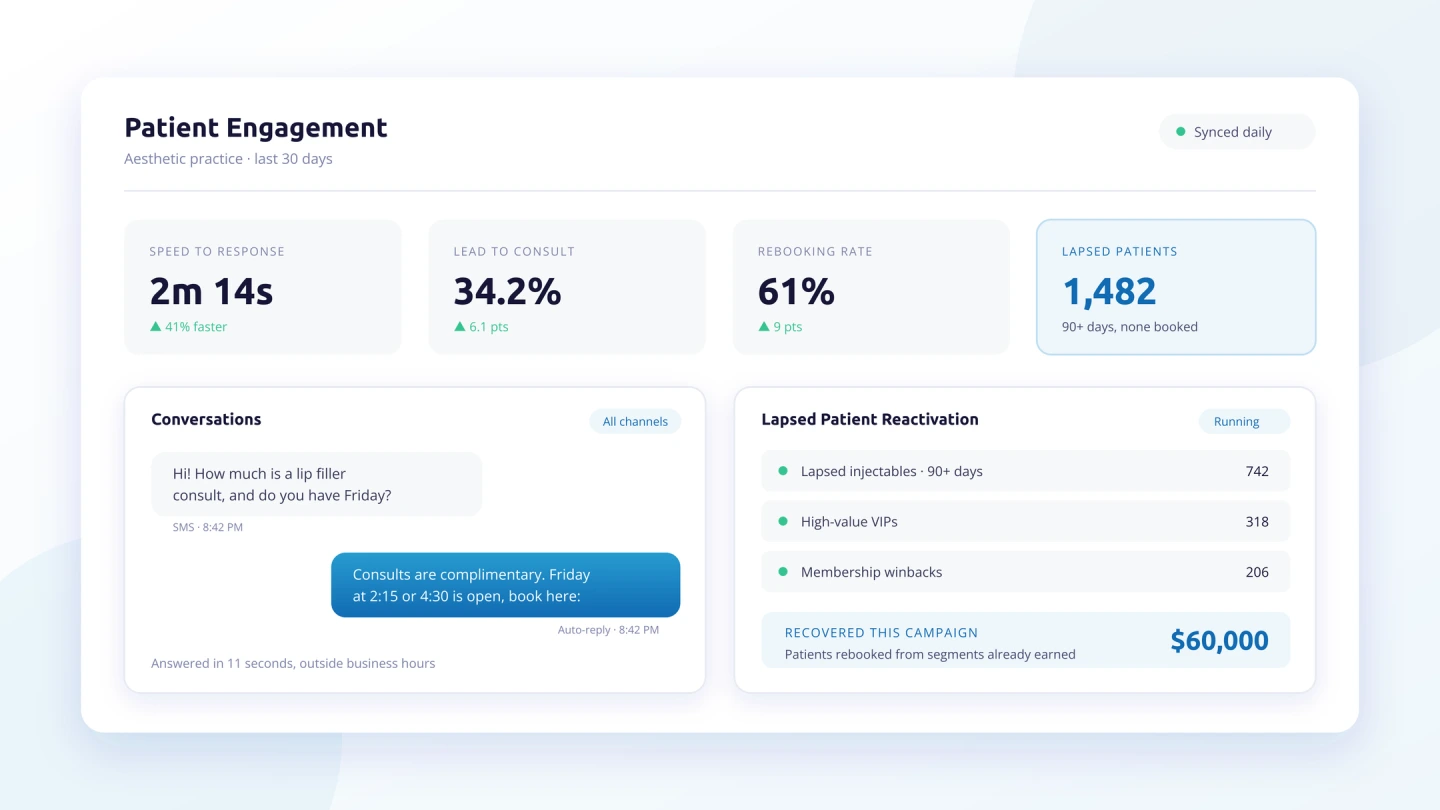
The measurable version of this job is speed to first response. In aesthetics it should be minutes, not hours, and it should hold outside business hours.
2. Hold a real two-way conversation
Broadcast alone does not convert. Patients reply with questions about pricing, downtime, and candidacy, and those replies need somewhere to go. This is the part a patient communication platform has to get right: a shared inbox so any team member can pick up a thread, conversation history attached to the patient record, and coverage for the hours your front desk is not staffed. This is where AI conversation handling earns its keep, since most inbound questions arrive after close.
3. Run reminders and treatment education
Confirmations, reminders, pre-treatment instructions, and post-treatment check-ins. This is unglamorous and it is the part that protects revenue you have already earned: fewer no-shows, better outcomes, fewer anxious calls to the front desk.
4. Reactivate lapsed patients
This is the job most platforms do worst and the one with the most money in it.
Patients lapse quietly (our guide to patient retention strategies covers why). There is no cancellation and no complaint, they just stop booking, and by the time anyone notices they have found another provider. Catching that requires knowing who has not returned and when they were due, which means the platform needs treatment history from your EMR, not just a marketing list.
This is exactly the gap Aesthetix Activate was built to close: it connects your EMR to a managed data warehouse, surfaces who is lapsing, and syncs those cohorts into automated reactivation campaigns in the CRM your team already uses. In one anonymized multi-location practice, a single neurotoxin reactivation campaign produced a 10.1% matured booking rate at $469 per completed visit, roughly 24 days from outreach to appointment. Read those as rates rather than totals, since a one to three location practice works from a smaller list.
5. Collect feedback and reviews
Reviews are the single strongest external signal for an aesthetic practice, and the reliable way to get them is to ask every satisfied patient automatically rather than occasionally. Reputation management belongs inside the engagement workflow, not in a separate tool nobody remembers to open.
How To Measure Patient Engagement
Most practices cannot answer whether engagement is improving because they are not measuring it. Four numbers cover it:
| Metric | What it tells you | Where practices land |
|---|---|---|
| Speed to first response | Whether inquiries are being caught | Minutes is good, hours is losing patients |
| Lead-to-consultation rate | Whether follow-up is working | Varies widely by source and offer |
| Rebooking rate | Whether patients come back on cycle | The clearest measure of engagement health |
| Lapsed patient count | How much revenue is sitting dormant | Almost always larger than practices expect |
The last one is the most useful and the least tracked. Count the patients who have not booked in 90 days and multiply by your average treatment value. That number is the size of the opportunity, and it is usually the number that makes practices act.
What To Look For When Evaluating A Platform
- Does it integrate with your EMR? Without treatment history, segmentation is guesswork. Ask specifically whether it reads visit and treatment data, not just demographics.
- Does it work across every channel patients actually use? Text and Instagram matter more than email in this industry.
- Can it handle compliance? Consent capture, quiet hours, and opt-out handling need to be built in. SMS in healthcare has real rules, and TCPA exposure is not theoretical.
- Will you sign a BAA? If protected health information touches the platform, this is not optional.
- Is the reporting honest? You want source-level attribution through to booked appointments, not impressions and open rates.
- Who configures it? The best platform in the world does nothing if nobody sets up the workflows. Ask what the vendor does versus what lands on your team.
Frequently Asked Questions
What is patient engagement software?
Patient engagement software manages communication with patients between visits: capturing and responding to inquiries, sending appointment reminders and treatment education, collecting reviews, and reaching out to patients who have not returned. In aesthetics it typically sits alongside an EMR, which holds the clinical record, and handles everything around the visit rather than the visit itself.
What is a patient engagement platform?
A patient engagement platform combines outbound communication, inbound two-way conversation, and the patient data that decides who to contact and when. The distinction from a point tool is that a platform shares one patient record across all of it, so a reminder, a campaign, and a text reply all belong to the same conversation history.
How is patient engagement software different from an EMR?
An EMR is the system of record for clinical care: charts, treatment notes, and the appointment calendar. Patient engagement software is the system of communication. Practices generally need both, and the useful question is whether they talk to each other. An engagement platform that cannot read treatment history from the EMR cannot tell you who is overdue.
How do I measure patient engagement?
Track four numbers: speed to first response, lead-to-consultation rate, rebooking rate, and the count of patients who have not returned in 90 days. Rebooking rate is the clearest single indicator of engagement health, and the lapsed patient count is the best measure of unrealized revenue.
Does AI help with patient engagement?
It helps most with coverage and speed. A large share of aesthetic inquiries arrive outside business hours, and an AI that answers questions, qualifies the inquiry, and sends a booking link keeps those leads warm until a human picks up. AI cannot place an appointment on your EMR calendar, so the honest version is that patients book themselves from the link, and the integration keeps the record straight.
How much does patient engagement software cost?
Pricing usually combines a platform fee with usage-based messaging costs, so compare total cost at your actual message volume rather than headline price. Watch for per-user pricing that punishes you for adding front desk staff, and for AI features metered per conversation, which makes cost unpredictable in a busy month.
Putting It Together
Patient engagement is not one feature, it is the operating layer between your marketing and your calendar. The practices that do it well are rarely the ones with the biggest ad budgets. They are the ones that answer fast, stay in touch on a cycle, and systematically go back to patients they have already earned.
If you want to see where the money is hiding in your own practice, start with the lapsed patient count. Pull the number of patients who have not booked in 90 days, multiply by your average treatment value, and decide whether that figure justifies doing something about it.
Book a demo and we will walk through what that looks like on your data.