How to Choose Med Spa Software: The 2026 Buyer's Guide

By Eric Dunn (CEO & Co-Founder, Aesthetix CRM)
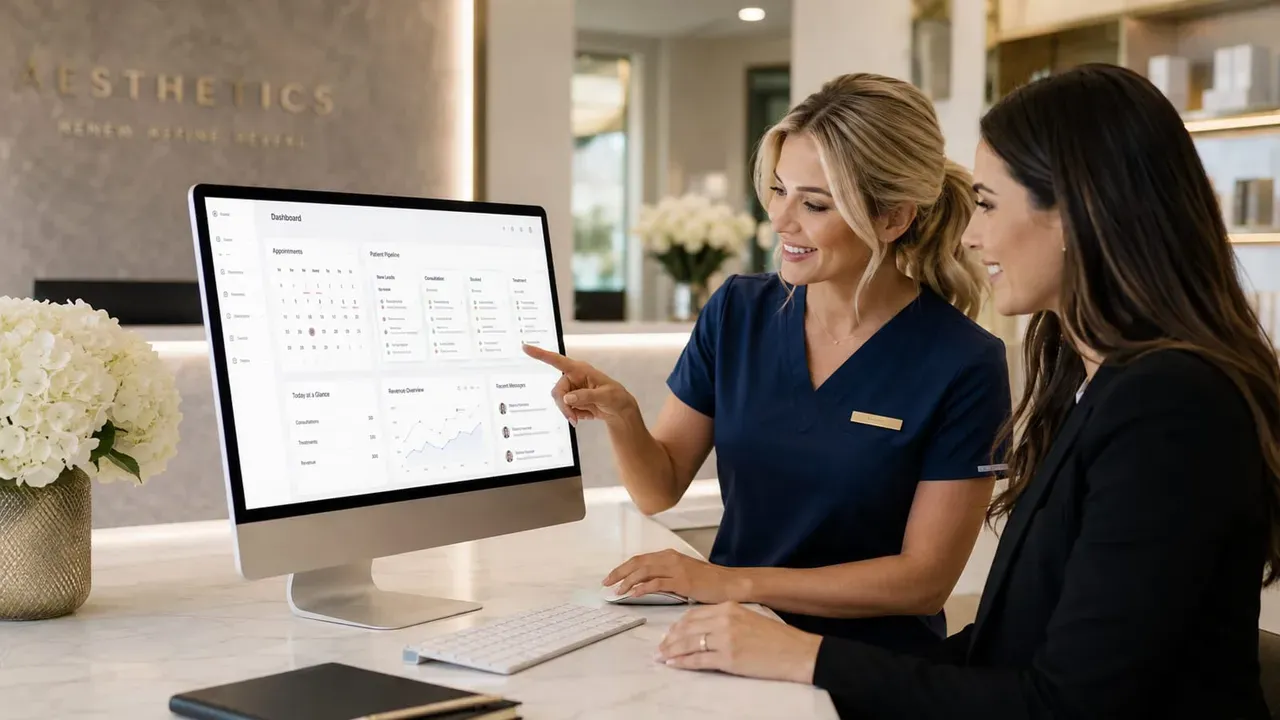
Choosing med spa software is one of the highest-leverage decisions a practice makes. The right platform keeps every lead warm while you sleep; the wrong one buries your front desk in tabs and lets paid leads go cold. This guide covers what medical spa software actually needs to do, the questions worth asking every vendor, and the red flags that predict a painful year.
The short version: the best med spa software captures every lead in one inbox, responds within minutes automatically, follows up until the visit is booked, proves which campaign produced it, and holds up to HIPAA scrutiny with a signed BAA. Everything below is how to verify a platform actually does those five things before you sign.
First, Know What You’re Actually Buying
“Med spa software” gets used for three different things, and mixing them up is the most common buying mistake:
- EMR / practice management: clinical records, charting, treatment documentation, inventory. This is your system of record for medicine.
- Booking platforms: calendars, scheduling, and point of sale.
- CRM and marketing software: lead capture, follow-up automation, patient communication, campaigns, and attribution. This is your system of record for growth.
Here is the same split at a glance:
| EMR / practice management | Booking platform | CRM & marketing software | |
|---|---|---|---|
| Manages | Charting, clinical records, inventory | Calendars, scheduling, point of sale | Leads, follow-up, campaigns, attribution |
| System of record for | Medicine | The schedule | Growth |
| The question it answers | “Is our documentation compliant and fast?” | “Can patients book without calling?” | “Why aren’t more inquiries becoming patients?” |
Some platforms try to be all three. In practice, most growing practices run an EMR they trust and pair it with a growth platform that integrates with it, because the software that’s great at charting is rarely great at converting a lead who filled out an ad form at 9pm. Whatever you choose, make sure you know which of the three jobs it’s actually built for, and how it connects to the others. (If it’s the clinical side you’re shopping for, start with our complete guide to evaluating EMRs for med spas and plastic surgery practices instead; this guide covers the growth side.)
The Feature Checklist
Score any platform you evaluate against this list.
Lead capture that catches everything
Your leads arrive from ads, your website, web chat, phone calls, Instagram, Facebook, and Google. If each channel lives in a different tool, leads fall through the gaps between them. Look for a unified inbox where every channel lands in one place, with the conversation history attached to the contact.
Speed-to-lead automation
The single biggest driver of consult bookings is how fast you respond. Minutes matter: a lead who hears back in under five minutes is dramatically more likely to book than one who waits hours. That’s only sustainable with automation: instant replies, an AI concierge for after-hours inquiries, and nurture sequences that keep following up until the appointment is on the calendar.
Booking and pipeline visibility
You should be able to see every open opportunity on one pipeline: who inquired, about what, how much it’s worth, and what happens next. Online booking with automated confirmations and reminders cuts no-shows and front-desk phone time at the same time.
Compliance-conscious patient communication
Aesthetic practices sit in a regulated space. Ask how the platform handles HIPAA: is a Business Associate Agreement (BAA) available? Is data encrypted at rest and in transit? How are SMS consent and opt-outs handled? Is texting A2P-registered? A vendor who answers these crisply has done the work; a vendor who just says “we’re fully compliant, don’t worry” hasn’t. (We wrote up exactly how this works on our side in our HIPAA-compliant CRM overview.)
Marketing automation and campaigns
Email and SMS campaigns, review requests after visits, reactivation sequences for dormant patients, and membership communication should all be workflows you configure once, not tasks someone remembers weekly.
Attribution you can trust
If you spend on ads, this is non-negotiable: every booked appointment should trace back to the campaign, ad, and keyword that produced it. Without source-level attribution you’re deciding budgets on gut feel. With it, you know precisely which campaigns pay for themselves.
Integrations with your existing stack
Your EMR, booking platform, phone system, and reporting tools are already in place. The growth platform should connect to them, not demand you replace everything at once.
Questions to Ask Every Vendor
- “Walk me through what happens when a lead fills out a Facebook ad form at 9pm on a Saturday.” The answer tells you everything about automation depth.
- “Will you sign a BAA, and what does your compliance model require from us?” Listen for the word “configuration.” Honest vendors describe compliance as shared work.
- “How does a booked appointment get attributed back to the ad that produced it?” Vague answers here mean you’ll never know your real ROI.
- “What does onboarding look like, and who does the setup work?” A platform is only as good as its implementation. Ask for the timeline, what’s included, and what’s on you.
- “Which EMRs and booking platforms do you integrate with today?” Today, not on the roadmap.
- “What happens to our data if we leave?” You want a clear export answer, in writing.
A Simple Five-Step Evaluation Process
You don’t need a six-month software committee. A focused evaluation looks like this:
- Shortlist by integration, not by feature list. Start from your EMR and booking platform and keep only the vendors that connect to them today. This usually cuts the field to three or four candidates in an afternoon.
- Bring your own scenarios to the demo. Ask each vendor to show your reality: a Facebook lead at 9pm, a no-show who needs rebooking, a patient who hasn’t visited in eight months. Scripted demos hide weak spots; your scenarios expose them.
- Model pricing at your real volume. Take your monthly contact count and campaign cadence and price out the subscription plus usage for each finalist, not the sticker price.
- Run the compliance check. Request the BAA, ask the consent and opt-out questions from the checklist above, and involve whoever owns compliance at your practice before you commit.
- Agree on the onboarding plan in writing. Who migrates the data, who builds the first workflows, and what “live” means by what date. Most failed software purchases fail here, not at the feature level.
Understanding Pricing Models
Med spa software pricing usually combines a platform subscription (often tiered by features), usage costs (SMS segments, email sends, and phone minutes, which are real and worth estimating from your actual volumes), and sometimes onboarding fees for setup and training. When comparing vendors, model your realistic monthly usage rather than comparing sticker prices. A cheaper subscription with expensive messaging can cost more at your volume.
For reference, Aesthetix CRM publishes everything: plans run $299 to $499 per month depending on tier, messaging rates are listed to the cent, and our SMS cost calculator estimates blast costs from your own contact count. Any vendor should be willing to get this specific; treat reluctance as an answer.
Red Flags
- No BAA available: an immediate disqualifier for a practice handling patient information.
- “All-in-one” claims with no integration list: usually means “replace everything or it doesn’t work.”
- No attribution story: if the demo never shows where bookings came from, the platform can’t tell you.
- Setup is entirely on you: expect stalled implementations and shelfware.
- Contracts that hide usage costs: ask for the messaging rate card up front.
Frequently Asked Questions
Do I need both an EMR and med spa software?
Usually, yes. The EMR is legally and clinically necessary for charting and treatment records, and a growth platform is what turns inquiries into booked appointments. They solve different problems, and the practices that grow fastest run one of each, connected. What you should avoid is paying twice for the same job, which is why the integration question comes before the feature comparison.
How long does switching med spa software take?
With a real onboarding program, most practices are live in a few weeks: data import first, then phone and messaging setup, then the first workflows. The timeline slips when the vendor hands you an empty account and a help center, which is why the onboarding question belongs in every demo.
What is a realistic monthly budget?
Plan for the subscription plus usage. Subscriptions for serious platforms tend to land in the low-to-mid hundreds per month, and usage scales with how aggressively you market. The more useful exercise is comparing total monthly cost at your volume across finalists, using each vendor’s published rates.
Can I keep my existing booking platform?
You should be able to. A growth platform worth buying integrates with the booking tools and EMRs aesthetic practices already run, rather than forcing a rip-and-replace. If a vendor’s answer to every integration question is “we replace that,” budget for the disruption that implies.
What is the single most important feature?
Speed to lead. Response time is the strongest lever on consult bookings that software can move, and it’s the one thing a busy front desk cannot fix without automation. If you only test one thing in a demo, test what happens in the first five minutes after a lead comes in.
Putting It Together
The best medical spa software for your practice is the one that catches every lead, follows up faster than a human can, keeps following up until the appointment is booked, proves which marketing paid for itself, and does all of it in a way your compliance posture can defend. Score your shortlist against the checklist above, ask the six questions, and weight the answers about automation and attribution most heavily. That’s where revenue actually moves.
If you want to see how Aesthetix CRM approaches all of the above (the unified inbox, the automation, the attribution, and the compliance model), start with our med spa software overview or book a demo and we’ll walk through it with your numbers.