Your Patients Are Booking at 9 PM: What 1.1 Million Appointments Say About Lead Nurturing
By Eric Dunn (CEO & Co-Founder, Aesthetix CRM)
Most advice about lead follow-up is guesswork dressed up as best practice. So when CloseBot published aggregate data from 1.1 million booked appointments across their platform, we read it closely. Their customer base is mostly local service businesses across a range of industries rather than aesthetics specifically, and they say so plainly in their methodology. But the behavior it captures is consumer behavior, and it lines up with what we see every day in med spas and plastic surgery practices.
Four of their findings should change how your practice handles inquiries.
The short version: just over half of bookings happen outside 9 to 5, weekend leads convert with 14% fewer messages than weekday leads, one booking in eight involves a lead who moved between channels, and the follow-up tail runs far longer than a 30 day sequence. Practices that only respond during business hours, on one channel, for one month are competing for a fraction of the demand they already paid to generate.
Finding 1: Half of Bookings Happen When Your Practice Is Closed
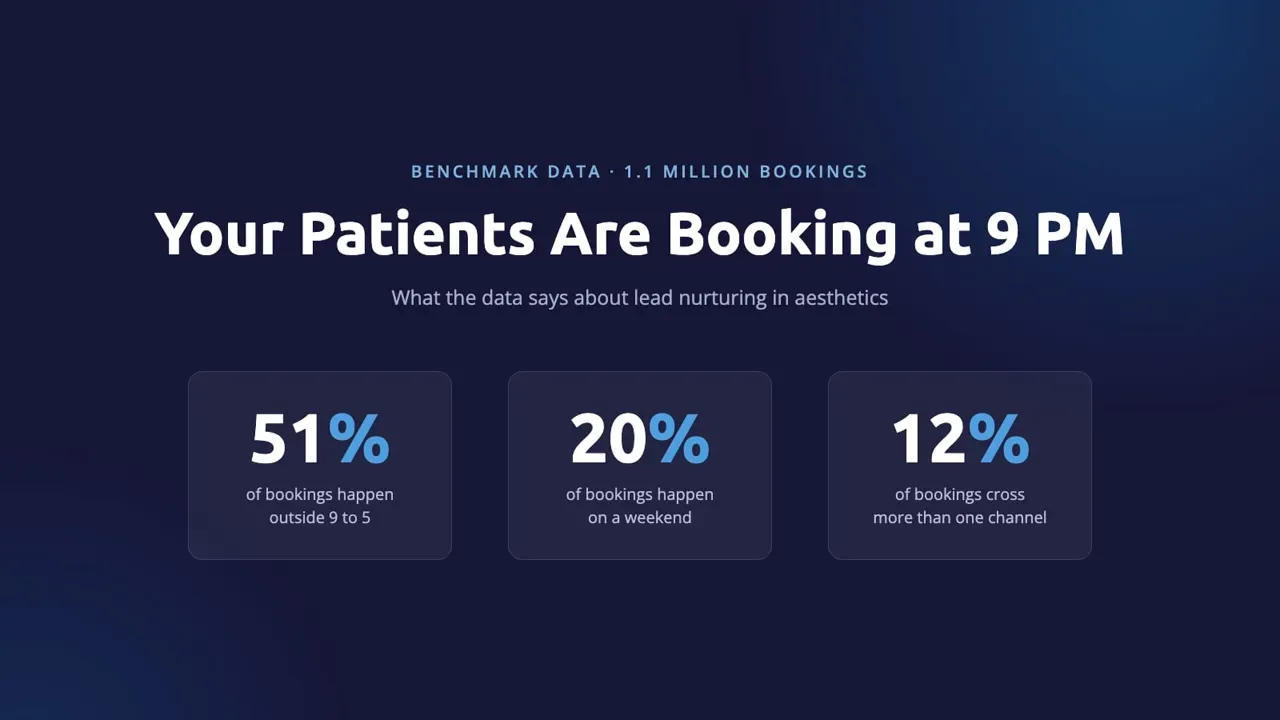
The headline number from CloseBot’s benchmark report is that 51% of bookings happen outside 9 to 5. Booking activity does not stop at 5:00pm; it declines gradually and stays meaningful until midnight. A third of all bookings land at 5:00pm or later, 16% arrive after 8:00pm, and the six hours between midnight and 6:00am still carry about 11%, roughly the same share as all of Saturday.
For aesthetics, that pattern is easy to explain. Nobody researches lip filler during a staff meeting. They research it after dinner, in bed, on a Sunday afternoon, in the gap between putting kids down and falling asleep. The moment a prospective patient decides they are ready is almost never the moment your front desk is staffed.
This is where the aesthetics-specific data reinforces the cross-industry data. CorralData’s H1 2026 benchmark of 100+ aesthetics brands found the fastest practices respond to new leads in under 13 minutes while everyone else takes anywhere from 4 hours to 24 days. Combine the two findings and the problem is obvious: the majority of inquiries arrive when nobody is there to answer, and the practices that answer fastest win the consult.
A form submission and a promise to call back tomorrow is not a response. By tomorrow, that patient has messaged two other practices.
Finding 2: Weekend Leads Are the Best Traffic You Get
Weekends account for 20.4% of bookings and they close with the least effort in the week. CloseBot measured messages per booking by day, and weekends converted with 14% fewer messages than weekdays. A Friday booking took 29% more messages than a Sunday one.
| Day | Share of bookings | Efficiency ratio |
|---|---|---|
| Sunday | 10.0% | 1.19 |
| Saturday | 10.4% | 1.07 |
| Tuesday | 17.2% | 1.01 |
| Monday | 17.5% | 1.00 |
| Wednesday | 16.1% | 0.98 |
| Thursday | 14.9% | 0.94 |
| Friday | 14.0% | 0.92 |
The efficiency ratio divides share of bookings by share of messages sent. Sunday produces 1.19 times the bookings its messaging volume would predict; Friday produces 0.92.
The likely explanation is intent. Someone engaging with your practice at 9:00pm on a Sunday is not idly browsing. They have time, they are thinking about themselves, and they want to be there. Weekend inquiries are the highest intent traffic of the week, and they are also the most likely to land in an inbox nobody opens until Monday.
Finding 3: One Lead in Eight Is Repeating Themselves
This is the finding with the clearest operational fix. About 12% of bookings involve a lead who was contacted or replied on more than one channel before booking. Meanwhile Facebook, Instagram, and live chat together held just 4.2% of last-touch credit. The cross-channel group is roughly 2.9 times larger than the entire last-touch footprint of every social and chat channel combined.
Two consequences follow, and both cost aesthetic practices money.
The first is attribution. Because cross-channel conversations tend to finish over text, the channel that closes takes all the credit and the channel that opened the conversation disappears from the report. If you are deciding whether to keep investing in Instagram based on last-touch numbers, you are reading a number designed to undercount it. Source-level attribution and reporting that captures first touch as well as last touch is the only way to see what a channel actually contributes.
The second is patient experience. If your Instagram DMs, web chat, and text messages live in separate tools with separate histories, then one patient in eight has to explain themselves twice. Someone who asked about Botox pricing on Instagram on Tuesday and texted you on Thursday should not be greeted like a stranger. CloseBot’s own conclusion from the data was that unified conversation state belongs in the base product, and we agree; it is why our all-in-one inbox puts every channel on one thread attached to one patient record.
Finding 4: Your 30 Day Sequence Ends Too Soon
The longest gap CloseBot recorded between first message and booked appointment was 355 days, just under a year. That is a single record rather than a distribution, and they are careful to say so. But the direction is the useful part: the lead you archived on day 90 may still be deciding.
The other planning number worth knowing is roughly 132 messages per booking, counting inbound replies and the leads who never respond at all. Most practices badly underestimate this because they model on the leads who converted and forget the rest of the list.
Aesthetic decisions are considered purchases. A patient weighing a surgical consult, or saving for a package of treatments, is not on a 30 day timeline.
A well-built nurture sequence runs something like ten touches across five weeks. That is a solid baseline and far better than the three or four touches many practices settle for. The gap this data exposes is not the sequence itself; it is what happens when the sequence ends. If a lead who has not replied by week five gets archived, the practice paid to generate that lead and then stopped talking to them while a meaningful share were still deciding.
The economics are different when follow-up is automated. A human coordinator with a quota and a finite calendar cannot afford to keep touching a 6 month old lead. An automated sequence has near zero marginal cost per touch, which makes patience rational in a way it never was before.
Answering Is Not the Same as Sending
There is a distinction buried in all of this, and getting it wrong creates real compliance risk.
Replying to someone who just messaged you is not the same as sending them a message. A patient who texts your practice at 9:00pm has started a conversation, and answering immediately is both good service and the behavior this data rewards. Automated outbound messages are a different matter. Quiet hours, consent, and opt-out handling govern when you may send marketing texts under the TCPA and carrier rules, and in nearly every platform arrangement the practice is the sender of record, which means those obligations sit with you rather than your software vendor.
So a well-run system does two different things at once. Inbound conversations get answered instantly, whenever they arrive. Scheduled outbound touches fire inside compliant sending windows, no matter how long the overall sequence runs. Extending a nurture horizon from five weeks to five months does not mean texting people at midnight; it means more patient, better-timed touches over a longer period. If you have not audited your send windows and consent language recently, our SMS compliance checklist and guide to opt-in texting laws are the place to start.
What to Do With This
Five changes, in the order I would make them:
- Answer inbound inquiries the moment they arrive, at any hour. An AI concierge that replies in seconds and sends a booking link at 9:00pm is the difference between capturing that inquiry and funding a competitor’s consult. Responding to someone who contacted you is always in bounds, and this is the highest return change available to most practices. A missed call text back does the same for phone inquiries.
- Treat weekend inquiries as priority traffic. They are your most motivated leads and the cheapest to convert. Make sure something answers them before Monday.
- Put every channel on one thread. Instagram, Facebook, Google Business, web chat, text, and email should resolve to one conversation on one patient record, so no patient repeats themselves and no channel disappears from your reporting.
- Extend the horizon, not the sending hours. A structured five week sequence is a strong baseline; what matters is what comes after it. Hand non-responders to a long-running reactivation campaign instead of archiving them, and keep every outbound touch inside compliant sending windows.
- Judge channels on source-level attribution, not last touch. Before you cut a channel, confirm you are looking at a number that credits where conversations start.
How This Works in Aesthetix CRM
Everything above is a systems problem, not an effort problem. Here is how our platform addresses each piece.
Instant response, around the clock. The AI Employee answers inquiries in seconds on any channel, at any hour, qualifies interest, answers common questions about treatments and pricing, and sends your booking link so the patient can schedule. Appointments land on your own calendars or on the EMR your practice already runs, through our EMR and booking integrations.
One inbox for every channel. Text, email, web chat, Instagram, Facebook, and Google Business messages arrive in a single conversation view with full history attached to the patient record, which is exactly the cross-channel state Finding 3 argues for.
Nurture that keeps going. Workflow automations run structured follow-up sequences and then move quiet contacts into long-running reactivation campaigns rather than dropping them. Sequences are yours to extend as far as your patient journey warrants, and outbound sends are scheduled inside compliant windows with consent capture and automatic opt-out handling built into the workflow layer.
Attribution that survives the handoff. Every contact carries first touch and last touch source from the first click through to the booked appointment, so channel decisions come from complete data.
Compliance-conscious by design. Patient communication runs on a platform built for HIPAA-compliant use, with a signed Business Associate Agreement available and A2P registered texting.
Frequently Asked Questions
When do most patients actually book appointments?
Across 1.1 million bookings measured by CloseBot, 51% happened outside 9 to 5, with a third landing at 5:00pm or later and 16% after 8:00pm. Weekends accounted for 20.4%. The data spans many local service industries rather than aesthetics alone, but the consumer pattern is consistent: people book when they are off work.
How long should a med spa lead nurture sequence run?
A structured sequence of roughly ten touches across five weeks is a strong baseline. The more important question is what happens when it ends. CloseBot recorded a booking 355 days after first contact, and aesthetic decisions often take months, so move non-responders into an ongoing reactivation campaign rather than archiving them. Extend the horizon, but keep outbound sends inside compliant hours regardless of how long the sequence runs.
Does my practice really need 24/7 lead response?
If half of inquiries arrive outside business hours, then a practice responding only during business hours is competing for roughly half of its own demand. You do not need staff at midnight; you need something that answers immediately and offers a way to schedule, then hands the conversation to your team in the morning. Note that this is about answering inbound messages, which is always permitted. Scheduled outbound campaigns are governed separately by quiet hours and consent rules.
What is cross-channel lead nurturing and why does it matter?
It means treating a patient who reaches you on Instagram, then by text, as one conversation rather than two. About 12% of bookings involve more than one channel. Without unified conversation history, those patients repeat themselves, and your reporting credits only the channel where the conversation happened to end.
Where does this data come from?
The booking figures are from CloseBot’s aggregate report on 1.1 million booked appointments across their platform, published with its methodology and limitations. The 13 minute response figure is from CorralData’s H1 2026 benchmark of 100+ aesthetics brands. Neither dataset is specific to our platform.
The Takeaway
The demand is already there. It arrives at 9:00pm on a Sunday, it starts on Instagram and finishes over text, and it takes longer to decide than your sequence is willing to wait. Practices that grow are not usually generating more leads than their competitors. They are simply present when the patient is ready.
If you want to see what that looks like running in one system, book a demo and we will walk through it against your own numbers.